
Media buying is crucial to the success of your advertising campaign. It helps you optimize your advertising spend and maximize reach to your target audience.

In Digital Advertising, Time is Money
We found that 64% of the time spent on an online campaign is spent in implementation, execution, and reporting. Much of this time is spent copy pasting Excel.
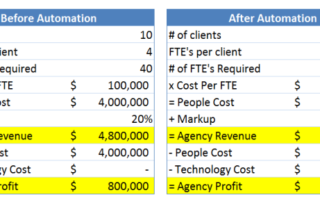
How agencies are punished for efficiency 91% of the time
The inefficiency of digital media buying is well-known. Tools and methods to improve workflow and efficiency have been developed over the years, but they’ve not been widely adopted. Could it be that agencies aren’t properly rewarded for being efficient? Or, worse yet, could it be that agencies are actually punished for being more efficient? Let’s take a look at the economics of efficiency at an advertising agency. Starting around 1990, agencies have moved from media commission models to hourly (or “cost plus”) pricing models. This movement has been accelerated by shift of advertising spending to relatively inefficient digital advertising. According to the 4A’s Labor Billing Survey Report, 91% of proposals today are priced based on hourly rates (despite scoring lowest among alternatives on the Grossman Grid). Imagine a new technology has been just been developed that doubles staff productivity through automation. In other words, this automation would enable you get the same amount of work done at the same level [...]

What is the RFC – Request for Consideration (vs. RFP)?
The “RFC” or “Request for Consideration” is new method of media planning that was introduced by NextMark in February 2012. The RFC is an alternative/complement to the “RFP” or “Request for Proposal” process that has been traditionally used in the media buying/selling process. The RFP and RFC are both methods for match-making among buyers and sellers. With the RFP, the buyer requests proposals from sellers. The RFC takes the opposite approach and turns the RFP process inside out. With the RFC, sellers request consideration from the buyer. In other words, the seller says “Here’s why I think this program deserves to be in your media plan. Will you please consider it?” The motivation for the RFC is the universal dissatisfaction with the RFP. It seems nobody in digital media likes the RFP. This inspiration for the RFC comes from interviews with buyers and sellers and an understanding of the dynamics of today’s digital media marketplace. The RFP works great in [...]

Why the RFP fails in digital media buying
As a follow up to the 9 ways the RFP fails in digital media buying, this article shows how today’s digital media landscape has rendered the RFP obsolete. The RFP process has been used in the advertising business since the beginning. But the dynamics of the media landscape has changed significantly since then. 50 years ago, in the Mad Men era, there were few media options to choose from. Think ABC, NBC, and CBS. Budgets were big. Planning cycles were long. Everyone knew everyone. It was easy to create your consideration set. The RFP process worked well in this environment of limited and static supply. We did not have all these problems with the RFP back in those days. Fast forward 50 years to today. We are in the digital media era. There are tens of thousands of digital media options to choose from and the landscape is evolving every day. Budgets are relatively small. Planning cycles are short. Staffing [...]

9 ways the RFP fails in digital media buying
“The RFP is broken” is often heard among digital media planning/buying and digital ad sales teams (called “buyer” and “seller” in this article). However, the RFP – or Request for Proposal – has remained an ingrained part of the digital media buying process for guaranteed inventory. This article explores the problems with using the RFP process in digital media buying. The purpose of the RFP The proposals that come in response to the RFP provide the buyer with benefits that include: Information – Proposals (RFP responses) contain the information a buyer needs to decide whether or not to include a given program in their media plan Ideas – proposals sometime present fresh “out of the box” ideas that benefit the advertiser Pricing – Proposals often include special negotiated pricing and other special terms Inventory – Proposals typically reveal how much inventory is available during the flight of the campaign How do RFP’s fail? Buyers and sellers cite the following problems [...]

Yikes – it costs an agency $40,356 to create and execute a digital media plan
There’s been a lot of talk about how inefficient the process of placing digital advertisements is as compared to TV and other traditional media. For example, according to Google, “Managing display ad campaigns can take up 28% of the budget in overhead, compared to 2% for TV. Which means for every $100 you spend on display, $28 goes to process management such as negotiation with multiple sites, re-planning, faxing insertion orders, trafficking hundreds of ad tags and so on. Such inefficiencies have impeded the growth of the industry.” Being process and workflow geeks, we wanted to understand this inefficiency at a deeper level. So, we conducted our own study to drill into this from a media agency’s perspective. The goal of the study was to answer a basic question: “How much does it cost an agency to create and execute a digital media plan?“ We faced our first big challenge right out of the gate. This question is not as [...]