How will AI transform media planning and buying? This report reveals what gets automated, emerging risks, and how agencies can position for an AI-driven future.
Introduction
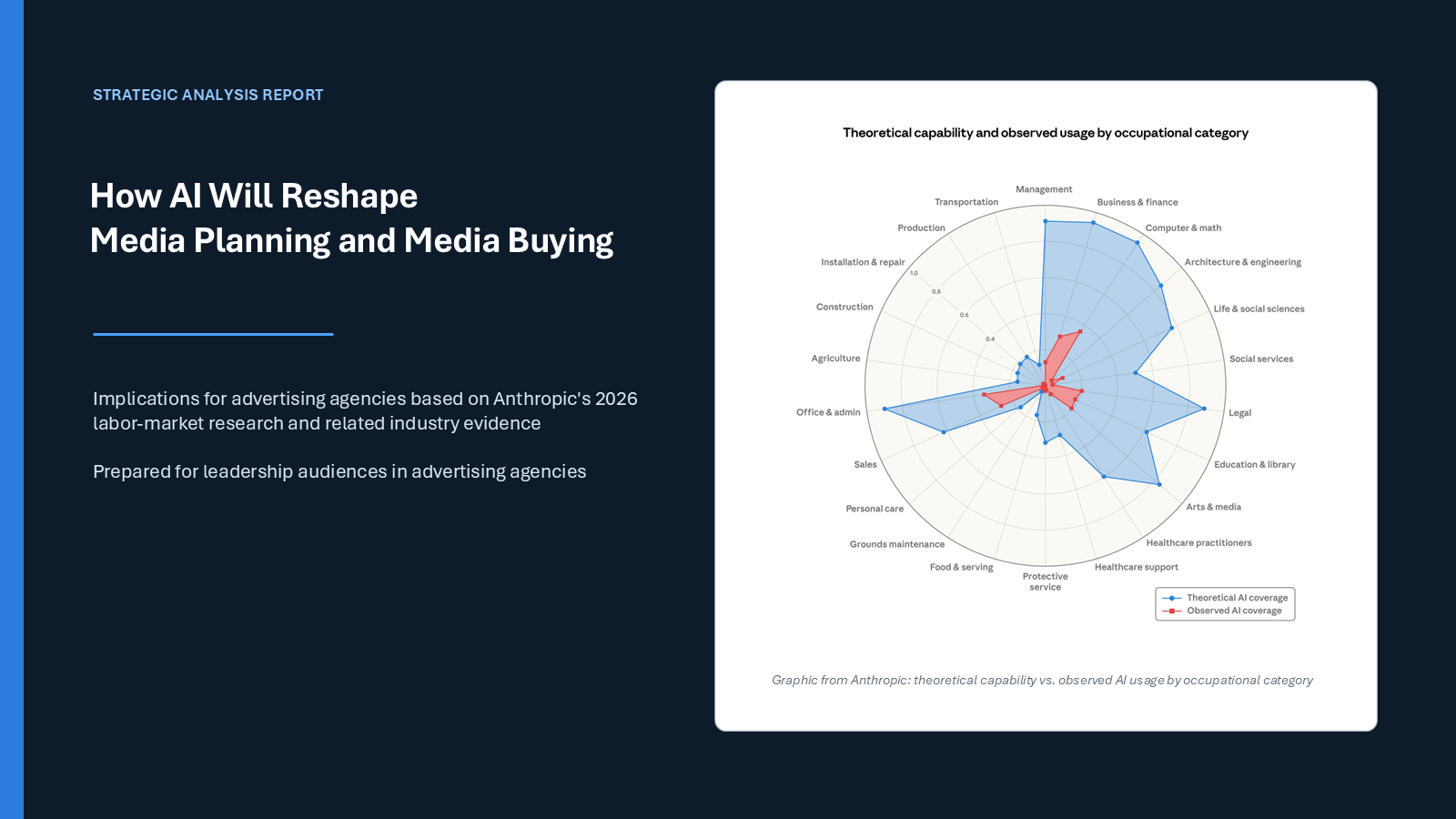
This report was commissioned to interpret the implications of Anthropic’s March 2026 research on labor-market exposure to AI for one specific sector: media planning and media buying inside advertising agencies.
Anthropic’s contribution is useful because it goes beyond abstract capability benchmarks and instead measures exposure where two conditions overlap: AI appears technically capable of doing the work, and people are already using AI in real work-related workflows.
The objective of this paper is not to restate Anthropic’s findings, but to translate them into an executive-level strategy for agencies. To do that, the analysis integrates evidence from IAB’s State of Data 2025, the World Economic Forum’s Future of Jobs Report 2025, McKinsey research on enterprise AI adoption, evidence from major ad platforms such as Google Ads, and labor-market baselines from the U.S. Bureau of Labor Statistics. Where relevant, it also incorporates credible reporting on platform roadmaps, including Reuters reporting on Meta’s automation ambitions.
Research question. What parts of media planning and buying are likely to be automated, where will human value persist, and how should agencies reposition their operating models, talent strategies, and client value propositions for an AI-native future?
Executive Overview
The most likely outcome is not wholesale elimination of media planning and buying, but a rapid compression of the operational layer of the function.
Anthropic’s report finds no broad employment collapse yet, but it does show that AI-exposed occupations are already experiencing softer growth expectations and weaker entry-level hiring dynamics. For agencies, that matters because the tasks most exposed to AI overlap heavily with the repetitive, analytical, data-intensive work that sits at the core of campaign planning, activation, optimization, reporting, and reconciliation.
At the same time, IAB’s industry evidence indicates that agencies are already among the most active adopters of AI on the buy side, especially in audience segmentation, optimization, data integration, and performance analysis. The strategic implication is that agencies will not win by defending manual workflow. They will win by moving up the value chain into strategy, orchestration, governance, measurement design, negotiation, and client counsel.
This shift is consistent with the broader workforce direction described by the World Economic Forum, which highlights analytical thinking, creative thinking, AI literacy, resilience, and continuous learning among the most important rising capabilities.
In short: the job remains, but the job description changes materially.
Implications at a glance
| Area | What AI automates | Where humans still matter most | Timing |
|---|---|---|---|
| Planning prep | Data gathering, taxonomy mapping, scenario drafts, first-pass media allocations | Business framing, objective-setting, client tradeoffs | Column 4 Now |
| Buying & optimization | Bid/budget adjustments, pacing, bidstream or platform tuning, anomaly detection | Objective selection, override decisions, seller negotiation | Now–12 mo |
| Reporting & analysis | Narrative summaries, dashboard commentary, variance alerts, next-best-action suggestions | Interpretation, escalation, client communication | Now |
| Entry-level work | Manual deck building, spreadsheet assembly, repetitive QA, workflow administration | Judgment development, apprenticeship, relationship skills | Now–24 mo |
How AI is likely to affect media planners and media buyers
Media planning and buying roles combine several distinct layers of work: data collection, audience definition, scenario modeling, channel selection, workflow administration, in-platform execution, optimization, reporting, and stakeholder communication.
The more a task is structured, repetitive, data-rich, and measurable against a near-term performance signal, the more exposed it is to automation.
That is precisely why Anthropic’s framework is so relevant to agency work: the operational portions of planning and buying fit the pattern of high AI exposure even if the broader client-service role does not.
Meanwhile, the market itself is moving in the same direction. Google’s AI Max roadmap shows the continued expansion of platform-native automation in targeting, creative enhancement, and query expansion. Reuters’ coverage of Meta points to a future in which large platforms aim to automate larger portions of ad creation and targeting directly inside their ecosystems. As platform automation deepens, agencies must differentiate above the platform, not simply within it.
Job functions most likely to be automated
The following functions are the most likely to be automated or heavily AI-assisted over the next 12 to 36 months:
- Audience segmentation and persona development. AI can cluster audiences, generate lookalike hypotheses, and synthesize campaign-ready targeting plans much faster than manual analysis, consistent with the top use cases in IAB’s 2025 research. See source.
- Budget pacing and bid optimization. Routine adjustments to spend levels, bid strategy, and inventory allocation are increasingly handled by platform automation and model-driven optimization loops. See source.
- Data ingestion, normalization, and first-pass reporting. AI is well suited to pull together campaign data, normalize fields, identify anomalies, and draft narrative summaries for internal and client-facing reporting. See source.
- Workflow administration. RFP support, QA checklists, note capture, action-item extraction, and trafficking support are highly automatable because they follow recognizable patterns and produce standardized outputs. See source.
- Junior analytical tasks. The historical apprenticeship work of building spreadsheets, stitching data, drafting decks, and producing routine analyses is especially vulnerable, which has implications for how agencies cultivate entry-level talent. See source.
What is likely to remain human for longer
The durable human layer of the role is concentrated in areas where ambiguity, trust, accountability, and multi-stakeholder judgment matter most. Those areas include:
- Translating client business goals into media strategy and deciding which tradeoffs actually matter
- Determining whether the machine is optimizing toward the right outcome instead of merely the most measurable one
- Integrating brand, creative, retail, PR, sales, and channel context into a unified recommendation
- Negotiating with media sellers and managing political or sensitive stakeholder dynamics
- Designing measurement, incrementality, attribution, and governance frameworks that sit above opaque platform black boxes
- Exercising accountability when model outputs conflict with brand safety, compliance, or client judgment
This is also where the labor market appears likely to keep rewarding humans. The BLS outlook for market research analysts and marketing specialists remains positive, suggesting that higher-order analytical and strategic marketing work should continue to matter even as narrower, more transactional tasks are automated.
Opportunities for advertising agencies
- Higher leverage per planner or buyer. Agencies should be able to manage more campaigns, more scenarios, and more client variations with the same or modestly larger teams.
- Faster cycle times. Planning, reporting, and optimization loops can move from days to hours, improving client responsiveness and reducing operational drag.
- Better scenario planning. AI can evaluate more combinations of audience, geography, inventory, pacing, and creative variation than a human team can reasonably model by hand.
- New advisory revenue. Agencies can expand into AI governance, data readiness, experimentation design, measurement architecture, and workflow transformation.
- Stronger enterprise positioning. Large clients will increasingly need an independent layer that can evaluate what platform algorithms are doing and whether those systems align with business outcomes, brand constraints, and financial controls.
These opportunities are reinforced by McKinsey’s enterprise AI research, which suggests that the highest-performing adopters do more than simply deploy generic tools; they customize workflows, manage risk, and embed AI into operating models that create measurable value.
Threats and strategic risks
- Margin compression on executional work as clients perceive less value in manual optimization and reporting.
- Client insourcing, particularly for smaller or mid-market accounts where platform-native automation reduces the complexity premium of an outside agency.
- Disintermediation by major platforms if agencies remain dependent on channel-specific execution rather than cross-platform decision support.
- A hollowed-out talent ladder if entry-level staff no longer learn the craft through the operational work that AI now absorbs.
- Governance failures, including hallucinated analyses, biased targeting recommendations, privacy risk, or optimization against the wrong business objective.
- Overreliance on black-box systems that reduce transparency with clients and weaken the agency’s ability to defend recommendations.
What agencies should do now
| Strategic move | Why it matters | Priority |
|---|---|---|
| Redefine the role | Rewrite planner and buyer roles around diagnosis, orchestration, judgment, client counsel, and governance rather than manual platform operation. | High |
| Own the layer above the platforms | Build cross-platform decisioning, measurement, auditability, and financial-control capabilities that clients cannot get from any one media platform. | High |
| Create proprietary agency intelligence | Train workflows on agency taxonomies, norms, benchmarks, client rules, and historical performance so the firm develops defensible IP. | High |
| Rebuild the apprenticeship model | Use simulations, structured reviews, and supervised AI workflows to teach judgment even as repetitive junior work disappears. | High |
| Shift the pricing model | Move away from billing that is anchored to manual labor hours and toward value, outcomes, governance, or managed complexity. | Med-High |
| Establish AI governance for media operations | Centralize tool approvals, review thresholds, data policies, disclosure standards, and incident management. | High |
12-24 month executive agenda
- Identify the top 20 planner and buyer workflows by hours consumed, then classify each as automate, augment, supervise, or retain.
- Select a small number of high-value AI pilots tied to measurable business outcomes such as faster planning cycles, better pacing accuracy, fewer reporting hours, or improved margin.
- Redesign job architecture and career ladders before attrition and hiring pressure force a reactive response.
- Invest in a durable system-of-record layer for campaign, pricing, workflow, and financial data so AI outputs are grounded in trustworthy operating data.
- Create a client narrative that clearly explains where AI increases efficiency, where humans remain accountable, and why the agency remains the safest steward of media investment.
Bottom line. AI will automate a large share of the operating mechanics of media planning and buying, but it will increase the value of agencies that can wrap those mechanics in superior strategy, measurement, governance, and client trust. The winners will not be the firms that resist automation. They will be the firms that turn automation into a new control layer and a better advisory model.
Selected sources
- Labor market impacts of AI: A new measure and early evidence.
- State of Data 2025: The Next Evolution of AI for Media Campaigns.
- World Economic Forum. The Future of Jobs Report 2025.
- The state of AI in early 2024: Gen AI adoption spikes and starts to generate value.
- An unconstrained future: how generative AI could reshape B2B sales.
- Introducing AI Max for Search campaigns.
- Meta aims to fully automate advertising with AI by 2026, WSJ reports.
- S. Bureau of Labor Statistics. Market Research Analysts: Occupational Outlook Handbook.