
Every marketer knows the score: dashboards are everywhere. Anyone can spin up shiny, interactive, and colorful dashboards that make you feel informed. But there is a massive difference between a pretty performance dashboard and a reliable system of truth.
Dashboards can be incredibly useful tools. They help you visualize performance trends, spot patterns in your creative, and tell stories about your campaign success. However, when it comes to the hard business of managing real advertising investments, you need something more: an advertising ledger.
While a dashboard visualizes self-reported platform data, an advertising ledger makes your advertising placements truly accountable to your media plans and media buys.
If your agency or marketing team relies solely on performance dashboards to make operational decisions, you don’t have all the information you need to optimize your advertising budget.
Here’s why an advertising ledger is the operational and financial truth engine you’ve been missing, and how it transforms the way you plan, execute, and reconcile your media investments.
The Limits of Dashboards
Dashboards excel at exactly what they were built for: data visualization. They pull in metrics from multiple channels such as Google, Meta, TikTok, and The Trade Desk, and show you trends over time.
However, typical dashboards only give you a tunnel-vision look backwards. They tell you what happened according to the advertising platform, not what actually happened in your real world of invoices, commitments, vendors, and cash flows.
A dashboard might show your last 30 days of impressions, clicks, and spend estimates. But when your CFO or client comes knocking with hard questions, a dashboard falls short.
Consider these scenarios where a dashboard cannot give you the answer:
- “What vendor commitments remain unpaid?” A dashboard tracks delivery, not liability.
- “Which bills are missing?” A dashboard doesn’t know what you haven’t received.
- “Is this flight actually delivering to contract terms?” A dashboard sees impressions, not contractual obligations.
- “Will the client be happy with performance?” Platforms report actuals, but not variance against the expectations set with the media plan.
A dashboard is not designed to be a financial truth engine. It is a visualization layer built on top of self-reported vendor data. And data surfaced without context isn’t truth. It’s just a signal.
Enter the Advertising Ledger
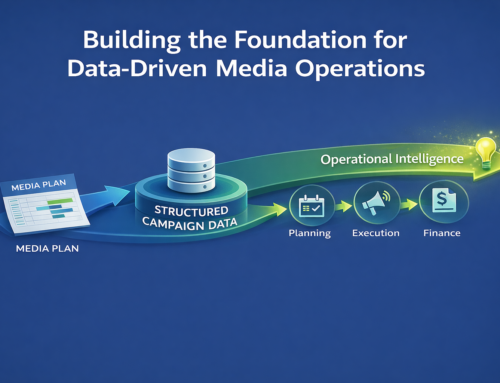
An advertising ledger is a structured, auditable account of every dollar you have planned, committed, ordered, delivered, and reconciled.
It lives deeper than day-to-day performance metrics. It tracks outcomes against contracts, invoices, and actual payments.
For media planners and buyers, moving from a dashboard mindset to a ledger mindset changes everything about how you operate.
1. Advertising Becomes Accountable to the Plan
In a dashboard-first world, a media plan is often just a directional spreadsheet. In a ledger-based system, a media plan is an accountable operational plan.
When you utilize an advertising ledger, you don’t just set campaign goals. You register contractual commitments and client expectations. Every line item on your media plan carries not just an intended spend, but all the related obligations. This means your planned numbers are tied directly to your budget caps, ensuring you never accidentally overcommit before the campaign even begins.
2. Buying Becomes Traceable
Insertion Orders (IOs) are the lifeblood of media buying, yet they often live in PDF limbo or email chains.
In an advertising ledger, IOs are not just administrative paperwork. They become ledger entries tied to specific vendors, terms, and timelines. You always know exactly what you have committed to pay, to whom, and when. This traceability protects the agency and the advertiser from surprise liabilities months down the road.
3. Execution Becomes Measurable Against Contracts
A dashboard tells you that you received 1 million impressions. A ledger tells you that you paid for 1.2 million impressions, revealing an under-delivery gap that needs to be made good.
By tying delivery data back to the actual cost basis, you move beyond “vanity metrics.” You can see if the deliveries meet the contracted specs and tie them back to revenue recognition. This empowers buyers to hold vendors accountable to the specific terms of the deal, not just the general performance trends.
4. Billing and Reconciliation Become Automated
Vendor bill reconciliation is a big pain point for media operations. “Reconciliation hell” occurs when the platform data says one thing, the media plan says another, and the vendor’s invoice says a third.
Dashboards cannot solve this. They don’t know how to reconcile an invoice against an IO.
An advertising ledger solves this by allowing vendor bills to flow in and get matched to real, committed obligations. Discrepancies aren’t abstract alerts; they are ledger variances (e.g., “Invoice exceeds IO by 5%”) that can be investigated, resolved, and closed.
Dashboard vs. Ledger: What’s The Difference?
A vital difference between dashboards and ledgers is that dashboards only show you what has already happened without any context. In contrast, a media planning system powered by a true advertising ledger enables you to see into the future and compare your actual performance against your initial plans.
For example, dashboards present historical KPIs such as impressions, clicks, and spend, letting you analyze completed campaigns. But a media planning system allows you to set targets for KPIs in advance (e.g., aiming for 1 million impressions or a $50,000 spend) and then track how your actual results stack up against your goals. This forward-looking approach supports better decision-making and accountability.
To put it simply, here is the breakdown:
- Dashboards visualize past platform delivery data.
- Advertising Ledgers give you foresight and reveal the truth about the past performance of your advertising investments.
Both matter, but only one is a source of truth. A dashboard can tell you what happened. A ledger can tell you if it’s bad or good.
For agencies and advertisers, this distinction has significant operational, financial, and strategic implications.
Why This Matters Now
As advertising has become more complex, media planning and media buying have become more complex. A single campaign might run across dozens of channels, from traditional TV, print, and OOH to programmatic display and social video. Metrics vary by publisher, billing cycles differ by vendor, and every team from strategy to finance needs shared trust in the numbers.
That trust doesn’t come from run-of-the-mill dashboards. It comes from a single, structured, auditable record of truth.
Companies that insist on managing media via dashboards and spreadsheets are prone to:
- Guesswork instead of confidence: Hoping the platform delivers what was planned.
- Manual reconciliation: Wasting countless hours manually matching PDF invoices to Excel rows.
- Disconnected teams: Marketing looks at one set of numbers while Finance looks at another, leading to internal friction.
Conversely, companies that invest in an advertising ledger win on all fronts:
- One source of truth: Alignment from the initial plan all the way to the final payment.
- Automated workflows: Electronic IOs and automated reconciliation replace manual chaos.
- Financial alignment: Teams align around real financial outcomes, not just headline KPIs.
Make the Advertising Ledger Your North Star
If you want to elevate your advertising operations from “look-good” metrics to real business truth, you’ve got to go beyond the dashboard.
Start by asking your team the right question: “Where is my authoritative record of commitments, deliveries, and bills?”
If the answer is “in a spreadsheet” or “in the dashboard,” you’re not seeing the whole picture.
When the answer is “in our advertising ledger” you know you’ve got a single, integrated system that reconciles planning, execution, and finance. You’re no longer just tracking results. You’re making them truly accountable.
Best of all, you don’t have to abandon your dashboards. You can upgrade your advertising dashboards by incorporating data from your advertising ledger. This way, you combine the presentation power of dashboards with the trustworthiness of your advertising ledger.
If you’d like to experience the power of a true advertising ledger, try Bionic for Agencies.