
Joe Pych writes about technology that automates media planning and media buying. Below are his archives.
Credentials:
You can reach Joe on LinkedIn.
Archives

The Digital Media Planner Happiness Project
As I talk about the automation benefits of our Digital Media Planner system, I use words like “easy, efficient, and effective.” But these words don’t capture the essence of what we are doing here from a media planner’s perspective. Here I try to get to the essence using the 5 whys method with a fictitious media planner, Paulette Planner: Q1: Why is workflow automation important in digital media planning? Paulette Planner: “Because it frees me from doing lots of mundane, robotic tasks like copying and pasting 600 placements from Excel into DFA.” Q2: Why is liberating you from mundane, robotic tasks important? PP: “Because it saves me time, eliminates tedious mistakes, and let’s me spend more time on higher-value, strategic activities.” Q3: Why is spending your time on high-value activities important? PP: “Clients pay for value. If I’m doing valuable work, then I’ll be happier with my job. Plus, I’ll get paid more and get promoted.” Q4: Why is your happiness [...]

3 Reasons Why “Programmatic Premium” Doesn’t Work Today
There’s been a lot of discussion lately about “programmatic premium” – using machines to fully automate the purchase of premium advertising inventory.

The 10 Biggest Problems with RFPs
It’s the fall media planning season. It’s the time of the year when leaves fall and make a mess of all the yards in the neighborhood. It’s also the time of the year when RFPs fall and make a mess of all the desks and inboxes in the media world. In The Fiesta Nobody Loves, Doug Weaver writes: “As we enter the fall season and another online advertising year begins to ebb, the human-powered agency RFP process continues — against all odds — to cling to life. For those looking in from the outside, the RFP (request for proposal) is a weekly ritual in which an agency sends out digital planning requirements to five times as many sites and networks as they’ll be able to buy from. The sales reps get all lathered up, put their entire organization into Def-Con 4 status, and turn a detailed proposal around in 36 or 48 hours with relatively little quality information and — unbeknownst [...]

John Henry vs. Programmatic Buying
Two articles published this week have caught my attention despite my recently self-imposed “information diet.” They rise above the din because of the keen observations they make on the changing workforce at advertising agencies. “There’s a lot of inexperienced people on the ground doing a lot of grunt work.” - Forrester analyst Joanna O’Connell in Agencies in the Age of Machines by Brian Morrissey “Accepting that there will be fewer and fewer staffers at the agency doing the grunt work of RFPs and spreadsheets: Do you really see more than a tiny handful of those people being retrained and redirected into right-brain Marketecture jobs?” – Upstream Group founder and CEO Doug Weaver in Brave New Agency The disruptive force here is the rise of automated, programmatic buying machines. These machines eliminate manual human toil and efficiently grind towards their narrow objectives. These articles remind me of the legend of John Henry vs. the steam-powered hammer. In this folk tale, the status quo [...]

Need a replacement for Google’s DoubleClick Ad Planner?
Google has announced it will discontinue many key features of its DoubleClick Ad Planner on September 5, 2012. However, good alternatives available to help you through the transition.

Building the Core of Your Agency
While it’s common for publishers to outsource their ad operations, it’s not yet common for agencies to outsource ad operations.

In Digital Advertising, Time is Money
We found that 64% of the time spent on an online campaign is spent in implementation, execution, and reporting. Much of this time is spent copy pasting Excel.
How agencies are punished for efficiency 91% of the time
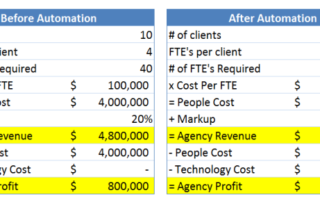
The inefficiency of digital media buying is well-known. Tools and methods to improve workflow and efficiency have been developed over the years, but they’ve not been widely adopted. Could it be that agencies aren’t properly rewarded for being efficient? Or, worse yet, could it be that agencies are actually punished for being more efficient? Let’s take a look at the economics of efficiency at an advertising agency. Starting around 1990, agencies have moved from media commission models to hourly (or “cost plus”) pricing models. This movement has been accelerated by shift of advertising spending to relatively inefficient digital advertising. According to the 4A’s Labor Billing Survey Report, 91% of proposals today are priced based on hourly rates (despite scoring lowest among alternatives on the Grossman Grid). Imagine a new technology has been just been developed that doubles staff productivity through automation. In other words, this automation would enable you get the same amount of work done at the same level [...]

5,000+ Top Digital Media Ad Programs Now Available In Bionic
Bionic has hit yet another milestone with the Digital Media Advertising Index: more than 5,000 of the top digital media advertising programs are now represented via data cards. It was just four months ago that we hit the 2,500 record milestone. Great momentum! The top publishers have been very enthusiastic about posting their data cards in the index for four good reasons: 1) It makes it easier for media planners to find them 2) It makes it easier for media planners to buy from them 3) It’s easy to use 4) It’s free The data card index complements other website indexing services like those from comScore, Nielsen, and Google that to a great job with website metrics such as number of visitors, page views, and basic visitor demographics. Those other services help media planners to find sites on which to advertise, but they don’t answer all questions a media planner needs to know when building a media plan such as: [...]

What is the RFC – Request for Consideration (vs. RFP)?
The “RFC” or “Request for Consideration” is new method of media planning that was introduced by NextMark in February 2012. The RFC is an alternative/complement to the “RFP” or “Request for Proposal” process that has been traditionally used in the media buying/selling process. The RFP and RFC are both methods for match-making among buyers and sellers. With the RFP, the buyer requests proposals from sellers. The RFC takes the opposite approach and turns the RFP process inside out. With the RFC, sellers request consideration from the buyer. In other words, the seller says “Here’s why I think this program deserves to be in your media plan. Will you please consider it?” The motivation for the RFC is the universal dissatisfaction with the RFP. It seems nobody in digital media likes the RFP. This inspiration for the RFC comes from interviews with buyers and sellers and an understanding of the dynamics of today’s digital media marketplace. The RFP works great in [...]