
Develop media plans that reach your target audience and achieve your desired results while staying within budget and adhering to industry best practices.

One Obvious Way to Save Publishing
The publishing business is under siege by technology. The New York Times is blaming exchange-traded media for its most recent declines in online display ad revenue. Federated Media just gave up on direct sales in favor of exchange-traded media. Meanwhile, CNET just reported that “Google generated $20.8 billion in ad revenue in the first six months of 2012, while the whole U.S. print media industry — newspapers and magazines — made only $19.2 billion.” The trend is clear: publishers are losing and the advertising technology intermediaries are winning. Does this really have to be a win/lose situation? A key topic at publishers’ board meetings must be, “How do we wrestle back control and get the revenue and income we deserve?” Here’s an obvious idea: make it easier for people to buy advertising from you. Today’s process to buy a digital advertisement directly is a mess. It’s a manual 42-step process taking an average of 48 hours per insertion order and costing buyers more than $4k [...]

“Air Traffic Control” for Media RFP Proposal Management
Last night, Bionic Digital Media Planning system was upgraded to give you a new tool for automatically keeping track of your Requests for Proposals (RFPs) and the proposals that come in response. RFP management in digital advertising is well-known to be a frustrating mess. Despite recently celebrating the eighteenth anniversary of the banner ad, sending RFP requests and handling proposal responses is still a highly manual effort involving emails, Excel spreadsheets, shared file folders, phone calls, sticky notes, and plenty of manual labor. Despite its many failings and costing agencies more than $3,000 per campaign in labor, nobody has yet developed a widely adopted alternative to this time-consuming and expensive process. Fresh on the heels of version 2.0, Bionic Planner v2.1, released May 9, 2013, brings much-needed automation to RFP management: Send RFPs from your media plan – with contacts pre-filled for you (no more tracking down contact info)! Automatically keeps track of who has viewed your RFP and who [...]

RFP and proposal management just got easier with Planner 2.0
Bionic today announced an upgrade to its digital media planning software, which adds key functionality for handling RFPs and media proposals. The Request for Proposal or RFP process in digital advertising is well-known to be a frustrating mess. Despite recently celebrating the eighteenth anniversary of the banner ad, sending RFP requests and handling proposal responses is still a highly manual effort involving emails, Excel spreadsheets, shared file folders, phone calls, sticky notes, and plenty of manual labor. Despite its many failings and costing agencies more than $3,000 per campaign in labor, nobody has yet developed a widely adopted alternative to this time consuming and expensive process. Bionic streamlines the RFP process with the latest upgrade to its Digital Media Planner system. Version 2.0 of Planner extends the platform’s functionality by enabling media planners to directly interact with publishers to request and manage media proposals. Now, instead of using spreadsheets and e-mail to negotiate pricing and placements, Planner’s Proposal Manager module [...]

How you Pay Your Agency Matters
The typical $500,000 digital media plan takes an alarming 42 steps and nearly 500 man hours to complete, which can cost up to $50,000.

If it’s not Programmatic Premium, then what is it?
I recently returned from an exciting IAB Annual Leadership Meeting in Phoenix, where a packed Arizona Biltmore resort was host to over 800 digital media luminaries. On the tip of many tongues over a two day session was “programmatic premium,” the term our industry is using to describe the buying of digital media in a more automated way. One particular “Town Hall” type meeting was particularly spirited, as leaders sparred over what “programmatic” meant, whether or not publishers should be using it, and how agencies were leveraging it. Here is what I heard: We are calling it the wrong thing. Like it or not, the term “programmatic” is tied to the concept of real time bidding. This is natural, given the fact that the last 5 years in ad tech have largely revolved around DSPs, SSPs, and cookie-level data. This creates a problem because, when you add the word “premium” into the mix, you have a really big disconnect. Most folks don’t [...]

When Cost-Plus is a Minus
It’s funny how people deride Microsoft for not being successful in advertising technology when 80% of digital media dollars are transacted using their media planning software. Despite the fact that we live in a world where computers can evaluate hundreds of individual bid requests on a single impression and render an ad serving decision in under 50 milliseconds, the overwhelming majority of display inventory is bought using e-mail and fax machines. Those media plans are manually created in Excel. Terence Kawaja of the famous LUMAscape maps, which depict the 300-plus companies who enable the 20% of display buying that happens programmatically, once said that “inertia is the agency’s best friend” when asked why holding companies were not doing more to bring innovation to advertising. I imagine that part of what he meant was that their common business model (billable hours plus a negotiated margin) does not create an incentive for efficiency. On the contrary, complexity in media planning means more billable hours—as [...]

New Tech Takes On Cost-Plus Pricing by Agencies
How the enterprise pays its ad agency actually matters. Here’s why. I have been working for a company that makes software solutions for buying digital media, and I have worked for a number of ad technology companies in the past. In a world where digital banner ads are still purchased through email and fax, and media plans are mostly created using Microsoft Excel — technology dating from 1985 — the ad technology industry sees an opportunity to create efficiencies in the way media is bought and sold. One of the odd industry dynamics we have encountered in bringing our product to market is how independent agencies are more apt to embrace new efficiencies than some of the “big four” owned agencies that lead the space in terms of media spend. Logically, you’d think that gigantic media agencies, managing hundreds of media planners and buying on thousands on digital media channels, would grasp at the chance to do more planning with [...]

What We Love, Hate and Desire in Our Digital Media Jobs
This presentation was given by Joe Pych at Digiday Agency Summit March 20, 2013 in Scottsdale, AZ. Two-thirds of people in digital media plan to change jobs in the next two years because they are unhappy. This survey reveals the source of unhappiness and makes recommendations to increase job satisfaction. To get a more detailed look at the findings, download the DAS SOTI March 2013 Happiness White Paper. Shameless self-promotion: Among many other things, this survey revealed that 76.1% of agencies use Microsoft Excel to create their media plans. It also revealed that 59.4% are not happy with their tools. Are you unhappy with wasting your life away in Excel? You should try NextMark’s Digital Media Planner tool. It’s free and better than Excel in at least 31 ways.

Media Planning in Excel is a Fool’s Errand
Yesterday, in a call with an agency president she said, “media planning in Excel is a fool’s errand.” Here's how media planning in Excel compares to Bionic.
Collaborate without fear with Bionic’s Digital Media Planner
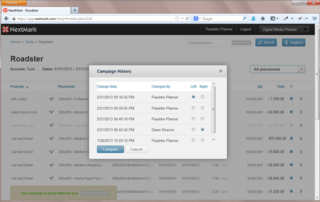
Bionic today unveiled advanced collaboration features in its Digital Media Planner system. With this upgrade, digital media planners can collaboratively develop digital media plans without fear of losing their work, which is common using today’s solutions. More than 80% of digital media agencies still use Microsoft Excel to produce their digital media plans. While flexible and easy to use, Excel has a long list of weaknesses that contribute to the high cost to create and execute a digital media plan. Some of Excel’s biggest weaknesses are it’s lack of support for collaboration and version control, which causes lost productivity. Excel spreadsheets are stored in a file format. As such, only the latest actively saved version is available. If you forget to save your changes or your machine crashes, your work is lost. If you and a co-worker unknowingly work on the same Excel media plan at the same time, your work will be lost if he saves his changes after [...]