
Increase your media planning and media buying productivity by automating tasks, organizing work, collaborating more effectively, and streamlining your workflow.
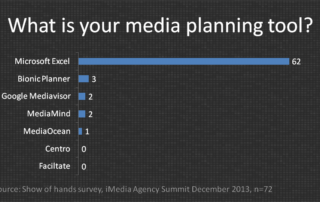
Here’s Why 86% of Digital Media Planners Still Use Excel
Why do they media planners stick with Excel when other options exist despite its well-known shortcomings? Here are reasons from the iMedia Agency Summit.

The Nuts and Bolts of Programmatic Direct
An interview with Econsultancy’s Monica Savut and Bionic's Chris O'Hara, on his recently published programmatic direct whitepaper. Econsultancy: Why now? In other words, why has this “programmatic direct” trend been on the radar lately? What’s driving all of the conversation the space? Chris O’Hara: It’s really something my boss Joe Pych calls the “Sutton Pivot,” inspired by the famous thief Willie Sutton who robbed banks “because that’s where the money was.” Over 70% of digital display dollars are transacted in a very manual way today. Despite all the LUMAscape hype over RTB, most of the digital money still gets transacted through the request-for-proposal (RFP) process. Everybody wants a piece of the action, hence the “Sutton pivot,” in which all the ad tech companies are running to try and provide automation technology for directly sold deals. It’s actually a good thing. Today’s process for buying guaranteed digital media can take over 40 steps and suck up over 10% of media budgets just in [...]

Programmatic Direct is in the Top of the Second Inning
Lately, I have been working on a whitepaper about the “programmatic direct” phenomenon. Part of the research involved surveying a bunch of influential people in the space, and asking them where they thought this new buying methodology was in terms of adoption. Their answers kind of surprised me. If “programmatic direct” was a baseball game, we are in the top of the second inning. The game has basically just started, and a few balls have been put into play, but the action is just getting started—and the big sluggers have yet to step up to the plate. If you are a regular AdExchanger reader, you would be justified in thinking that programmatic direct was quickly gaining steam by progressive agencies and publishers. After all, there has been a good deal of hype surrounding the idea of enabling programmatic access to higher classes of inventory, and it seems like almost every ad technology player in the display space is getting into [...]

The Tiger in the Bathroom: Agency Hangover
Digital media agencies face a challenge similar to the cast of The Hangover because they lack an agency information repository.

Programmatic Direct Isn’t Just About Efficiency
When you are selling anything, it’s really easy to get caught up in pitching the benefits of your product, and ad technology is no different. Some of today’s new programmatic direct marketing solutions promise to change the very nature of how media buyers and sellers spend their time. Demand side systems are focusing on replacing Excel and e-mail with web-based, centralized systems that take the manual grunt work out of buying. Supply-side systems are tying into publisher ad servers to help create more streamlined access to inventory, without the hassles of secure it via paper insertion orders. While it’s easy to focus on all of the amazing efficiency benefits offered by today’s web-based solutions, it’s also critical to remember to ask your client what’s important to them. On a recent sales call to a large agency, my old-school sales training kicked in. After showing off all of the neat bells and whistles of my software, I asked the company’s Chief [...]

Agency Operating Systems are the New Battleground
With the inefficiencies in digital media buying today, your agency’s operating system is becoming a critical factor in winning new business, hiring the best talent, and operating profitably.

The Hourglass Funnel Changes Everything
Lately, I’ve been thinking a lot about the hourglass funnel. Most funnels stop at the thin bottom, when a customer “drops” out, having made the journey through awareness, interest, desire and action. After the “action,” or purchase, the customer gets put into a CRM to be included in more traditional marketing outreach efforts, such as calls, e-mails, and catalogue mailings. In the past, marketers often thought about how to turn customers into advocates, but couldn’t figure out how to do it at scale. Companies that were really good at multi-level marketing, like Amway, didn’t have easy-to-replicate business models. Today, the situation has changed. Social-media platforms give marketers tools to engage customers in their CRMs and bring them back through the bottom of the funnel, turning them into brand advocates — and maybe even salespeople. This is why Salesforce has been snatching up social-media companies like Radian6 and Buddy Media, while Oracle bought Vitrue and Involver. These platforms can help get people talking about your [...]

Complexity is the Digital Ad Agency’s Best Friend
I once heard Terence Kawaja remark that “complexity is the agency’s best friend.” It’s hard to argue with that. Early digital agencies were necessary because doing things like running e-mail campaigns, building websites, and buying banner ads were really complicated. You needed nerdy guys who knew how to write HTML and understood what “Atlas” did. Companies like Operative grew admirable services businesses that took advantage of the fact that trafficking banner ads really sucked, and large publishers couldn’t be bothered to build those capabilities internally. The early days were great times for digital agencies. They were solving real problems. Fast forward 13 years. Digital agencies are still thriving, mostly by unpacking other types of complexity. “Social media experts” were created to consult marketers on the new social marketing channel, “trading desks” launched to leverage the explosion of incomprehensible RTB systems, and terms like “paid, owned, and earned” were coined to complexify digital options. It’s hard being a marketer. So much [...]
Stealing Some of Microsoft’s Ad Tech Market Share
When you think of advertising technology in the display space, the first names you’re likely to think of are Google, PubMatic, Adobe, and AppNexus. But Microsoft? Not really top of mind, unless you are thinking of its disastrous aQuantive acquisition in 2007. Sure, every now and then MSFT will pick up the odd Rapt or Yammer, but is it really having a huge impact in the ad tech space? Even if you’re a regular AdExchanger reader, you’d be justified in thinking it’s not. But you’d be 100% wrong. Microsoft has been quietly running the inner ad-technology workings of digital display since the first banner ad was purchased in 1995. According to some recent research, the company’s ad-planning software boasts an amazing 76% market share among agency media planners. MediaVisor ranks a distant second with a measly 9.7 Almost nine in 10 planners who use Excel spend more than an hour a day using its software, while almost 35% use it for more than four hours per day. That [...]

The Elephant in the Room: Agency Compensation
Earlier this month, during the Agency-Only Day at the iMedia Agency Summit, I gave a presentation on agency automation and streamlining the media planning process. It’s a complicated and expensive process still done manually at most agencies.