
Increase your media planning and media buying productivity by automating tasks, organizing work, collaborating more effectively, and streamlining your workflow.

2013 Will be the Year of Programmatic Direct
Fairfax Cone, the founder of Foote, Cone, and Belding once famously remarked that the problem with the agency business was that “the inventory goes down the elevator at night.” He was talking about the people themselves. For digital media agencies, who rely on 23 year-old media planners to work long hours grinding on Excel spreadsheets and managing vendors, that might be a problem. For all of the hype and investment behind real-time bidding, the fact is that “programmatically bought” media (RTB) will only account for roughly $2B of the anticipated $15B in digital display spending this year, or a little over 13% depending on who you believe. Even if that number were to double, the lion’s share of digital display still happens the old fashioned way: Publishers hand-sell premium guaranteed inventory to agencies. Kawaja map companies, founded to apply data and technology to the problem of audience buying, have gotten the most ink, most venture funding, and most share of [...]

How you Pay Your Agency Matters
The typical $500,000 digital media plan takes an alarming 42 steps and nearly 500 man hours to complete, which can cost up to $50,000.

When Cost-Plus is a Minus
It’s funny how people deride Microsoft for not being successful in advertising technology when 80% of digital media dollars are transacted using their media planning software. Despite the fact that we live in a world where computers can evaluate hundreds of individual bid requests on a single impression and render an ad serving decision in under 50 milliseconds, the overwhelming majority of display inventory is bought using e-mail and fax machines. Those media plans are manually created in Excel. Terence Kawaja of the famous LUMAscape maps, which depict the 300-plus companies who enable the 20% of display buying that happens programmatically, once said that “inertia is the agency’s best friend” when asked why holding companies were not doing more to bring innovation to advertising. I imagine that part of what he meant was that their common business model (billable hours plus a negotiated margin) does not create an incentive for efficiency. On the contrary, complexity in media planning means more billable hours—as [...]

New Tech Takes On Cost-Plus Pricing by Agencies
How the enterprise pays its ad agency actually matters. Here’s why. I have been working for a company that makes software solutions for buying digital media, and I have worked for a number of ad technology companies in the past. In a world where digital banner ads are still purchased through email and fax, and media plans are mostly created using Microsoft Excel — technology dating from 1985 — the ad technology industry sees an opportunity to create efficiencies in the way media is bought and sold. One of the odd industry dynamics we have encountered in bringing our product to market is how independent agencies are more apt to embrace new efficiencies than some of the “big four” owned agencies that lead the space in terms of media spend. Logically, you’d think that gigantic media agencies, managing hundreds of media planners and buying on thousands on digital media channels, would grasp at the chance to do more planning with [...]
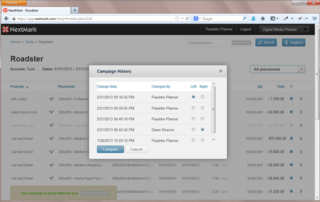
Collaborate without fear with Bionic’s Digital Media Planner
Bionic today unveiled advanced collaboration features in its Digital Media Planner system. With this upgrade, digital media planners can collaboratively develop digital media plans without fear of losing their work, which is common using today’s solutions. More than 80% of digital media agencies still use Microsoft Excel to produce their digital media plans. While flexible and easy to use, Excel has a long list of weaknesses that contribute to the high cost to create and execute a digital media plan. Some of Excel’s biggest weaknesses are it’s lack of support for collaboration and version control, which causes lost productivity. Excel spreadsheets are stored in a file format. As such, only the latest actively saved version is available. If you forget to save your changes or your machine crashes, your work is lost. If you and a co-worker unknowingly work on the same Excel media plan at the same time, your work will be lost if he saves his changes after [...]

Why is automation important to digital media directors?
Here is the presentation I gave this morning to a packed room of 70 media executives at the iMedia Agency Summit at the Camelback Inn in Scottsdale, AZ
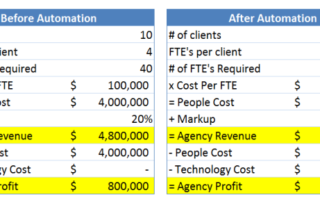
How agencies are punished for efficiency 91% of the time
The inefficiency of digital media buying is well-known. Tools and methods to improve workflow and efficiency have been developed over the years, but they’ve not been widely adopted. Could it be that agencies aren’t properly rewarded for being efficient? Or, worse yet, could it be that agencies are actually punished for being more efficient? Let’s take a look at the economics of efficiency at an advertising agency. Starting around 1990, agencies have moved from media commission models to hourly (or “cost plus”) pricing models. This movement has been accelerated by shift of advertising spending to relatively inefficient digital advertising. According to the 4A’s Labor Billing Survey Report, 91% of proposals today are priced based on hourly rates (despite scoring lowest among alternatives on the Grossman Grid). Imagine a new technology has been just been developed that doubles staff productivity through automation. In other words, this automation would enable you get the same amount of work done at the same level [...]

Why the RFP fails in digital media buying
As a follow up to the 9 ways the RFP fails in digital media buying, this article shows how today’s digital media landscape has rendered the RFP obsolete. The RFP process has been used in the advertising business since the beginning. But the dynamics of the media landscape has changed significantly since then. 50 years ago, in the Mad Men era, there were few media options to choose from. Think ABC, NBC, and CBS. Budgets were big. Planning cycles were long. Everyone knew everyone. It was easy to create your consideration set. The RFP process worked well in this environment of limited and static supply. We did not have all these problems with the RFP back in those days. Fast forward 50 years to today. We are in the digital media era. There are tens of thousands of digital media options to choose from and the landscape is evolving every day. Budgets are relatively small. Planning cycles are short. Staffing [...]