
Need a broadcast calendar? Here is a collection of ungated, free download broadcast calendars 2023-2026 in various formats including PDF, PNG, JPEG, DOC, and PPT. These broadcast calendars are fully customizable.
What is a Broadcast Calendar?
The broadcast calendar is a specialized calendar created by the advertising industry to standardize how linear TV and radio advertising is scheduled and billed. Unlike the Gregorian calendar (the one we use every day), which starts months on different days of the week, the broadcast calendar keeps things consistent:
- Every broadcast week starts on Monday and ends on Sunday.
- Every broadcast month starts on a Monday and ends on a Sunday, and contains either 4 weeks (28 days) or 5 weeks (35 days)
This alignment ensures that programming, ratings, and invoices are all based on the same weekly structure.
2026 Broadcast Calendar

A collection of 2026 Broadcast Calendars
Here is the 2026 Broadcast Calendar in various formats including PDF, PNG, JPEG, DOC, and PPT.
2025 Broadcast Calendar

A collection of 2025 Broadcast Calendars
Here is the 2025 Broadcast Calendar in various formats including PDF, PNG, JPEG, DOC, and PPT.
2024 Broadcast Calendar

A collection of 2024 Broadcast Calendars
Here is the 2024 Broadcast Calendar in various formats including PDF, PNG, JPEG, DOC, and PPT.
2023 Broadcast Calendar
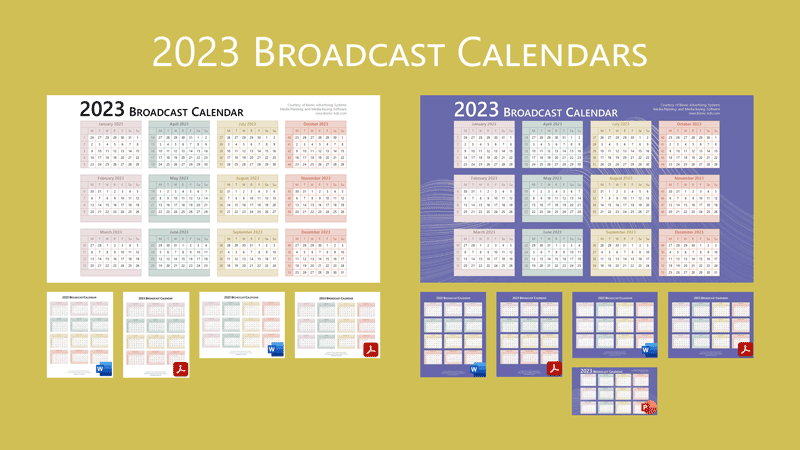
A collection of 2023 Broadcast Calendars
Here is the 2023 Broadcast Calendar in various formats including PDF, PNG, JPEG, DOC, and PPT.
How Broadcast Calendars in Media Planning and Media Buying
Broadcast Calendars are used frequently in traditional TV and radio media planning and media buying.
In traditional media, programming schedules, ratings reports, and ad delivery are all organized by weeks. If advertisers used the regular calendar, months would overlap weeks unevenly, making it nearly impossible to line up spots, track delivery, and reconcile billing.
The broadcast calendar solves this problem by putting everyone on the same system. Here’s how it helps in practice:
- Flighting: Campaign flights are easier to enter into a media plan because weeks are always Monday–Sunday.
- Budgeting: Invoices line up with delivery periods, avoiding mismatches between what aired and what got billed.
- Pacing: Media buyers can track spend and impressions against clean four- or five-week blocks.
- Post-Analysis: Ratings and GRPs (gross rating points) are reported in weekly increments, which match directly to the broadcast calendar.
The Catch
Because broadcast months don’t always match standard (Gregorian) months, media planners and buyers have to reconcile 28-day and 35-day months with client budgets, which are usually set in calendar months or fiscal quarters.
That’s why many agencies rely on media planning software like Bionic for Agencies to handle the math automatically, so planners can focus on strategy instead of spreadsheets.