

RFPs play an important role in media planning and media buying. But RFPs will drain your time and energy if done manually. Here’s how to automate your RFPs.
Included RFP Automation
It’s easy to automate your media planning RFP workflow with Bionic for Agencies – the #1 rated, modern, affordable, all-in-one media planning and buying tool:
✨ Create RFPs with templates.
📤 Send RFPs in batch.
🕵️ Track RFP opens, responses, and progress.
📥 Receive standardized proposals.
💬 Discuss RFPs and proposals with online chat.
❌ Reject or request revisions online.
✅ Accept line items into your media plan with one click.
🏖️ Enjoy less stress and more free time!
What is an RFP in Media Planning?
In media planning, you have virtually infinite possibilities for placing your ads. RFPs facilitate your selection of vendors with the aim of maximizing both the efficiency and effectiveness of your media buys.
An RFP, or Request for Proposal, is a document that you send to potential vendors which defines your advertising campaign’s requirements, objectives, target audience, timeline, and budget. The goal is to elicit proposals from vendors, which detail how they will meet your requirements with advertising placements, their available inventory, pricing options, terms and conditions, and ordering instructions.
RFPs Set Clear Expectations
RFPs set clear expectations with potential vendors. This helps vendors to formulate a creative proposal that meets your needs. It also provides a baseline against which to evaluate vendor proposals when they arrive.
RFPs Create Accountability
RFPs also introduce a level of accountability and transparency into the process. By explicitly stating your needs, goals, and evaluation criteria, you ensure a fair selection process. This process helps to document justify your decisions.
But RFPs Can Be an Administrative Nightmare
Despite the benefits of using RFPs, the process has its drawbacks.
Described by Doug Weaver as “the fiesta nobody loves,” RFPs are notoriously time-consuming, laborious, and difficult to manage. Here are eleven of the challenges you face in this process:
- Choosing your “consideration set” from among thousands of potential vendors.
- Tracking down contact information for each of the vendors in your consideration set.
- Sending RFPs to vendors.
- Following up with vendors on the status of their RFPs.
- Reminding vendors to submit RFPs.
- Missing deadlines.
- Gathering proposals from vendors and organizing them.
- Requesting revisions to proposals that need more work.
- Comparing proposals against each other.
- Rejecting proposals that don’t make the cut.
- Accepting proposals into your media plan.
RFPs and Inconsistent Proposals
Given free rein, vendors will respond with inconsistent proposals. One vendor might provide a detailed, comprehensive proposal, while another might offer minimal information. This makes it difficult for you to compare alternatives.
How to Streamline Your RFP Process
Thankfully, there’s a way for you to do RFPs without all these problems.
Bionic for Agencies is a modern media planning system that was built from the ground up to streamline your workflow, and to automate your RFP process.
Automate Your RFP Workflow

Bionic streamlines your RFP process, saving you precious time and resources:
- Find the best vendors by searching Bionic’s vendor database.
- Send RFPs with the click of a button.
- Track RFP progress online, just as you do with a package delivery.
- Automatically remind vendors to submit their proposals.
- Vendors respond with proposals via Bionic for Ad Sales.
- Receive proposals online.
- Accept or reject proposals online.
In other words, no more Word docs, Excel templates, email, filing, nor copying and pasting.
Standardize Vendor Proposals

Bionic forces your vendors to respond in a consistent format through a standardized template.
Don’t worry, this doesn’t add a burden to the vendors. It actually makes their job easier. Bionic provides them with proposal building tools and the ability to upload avails from their inventory system.
This ensures that every proposal comes to you in a consistent format, which makes it easier for you to compare proposals and make the best decisions.
Better Communication
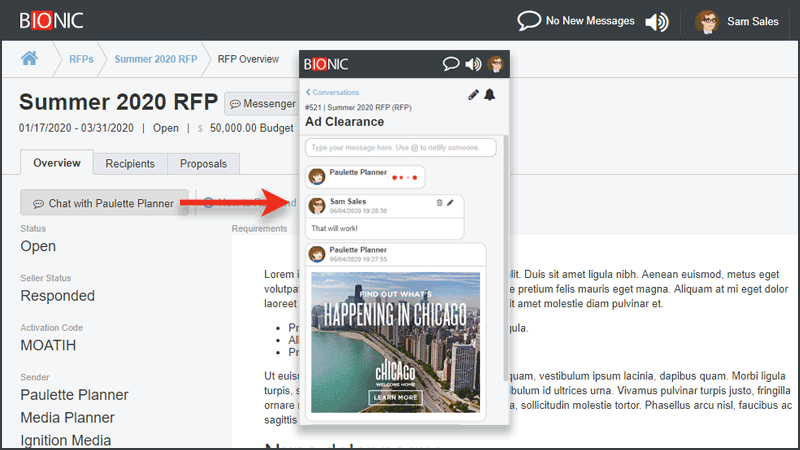
Besides the improved communication provided in the RFPs and proposals themselves, Bionic also gives you the ability to chat in real-time with your vendors via Bionic Messenger.
This open line of communication will lead to better proposals and, ultimately, a better media plan.
Better Documentation

All your RFPs and Proposals are stored in a database and automatically attached to your campaign. This keeps all your documentation perfectly organized and easily available for everyone on the media team.
Plus, all your communication through Bionic messenger is automatically attached to your RFPs, giving you a clear record of all your discussions and negotiations.
How to Get Started with RFPs on Bionic
If you’re already using Bionic for Agencies, you already have access to all this RFP automation. You’ll find this under the RFPs tab in each of your campaigns.
Please let us know how we can help you to leverage this powerful tool. Remember, you get unlimited training and support with your Bionic subscription. We’re here to help you!
If you’re not yet on Bionic, it’s never too late to get started.
You can learn more about the system, see pricing, see reviews, watch a demo, and start a trial on the Bionic for Agencies web page.