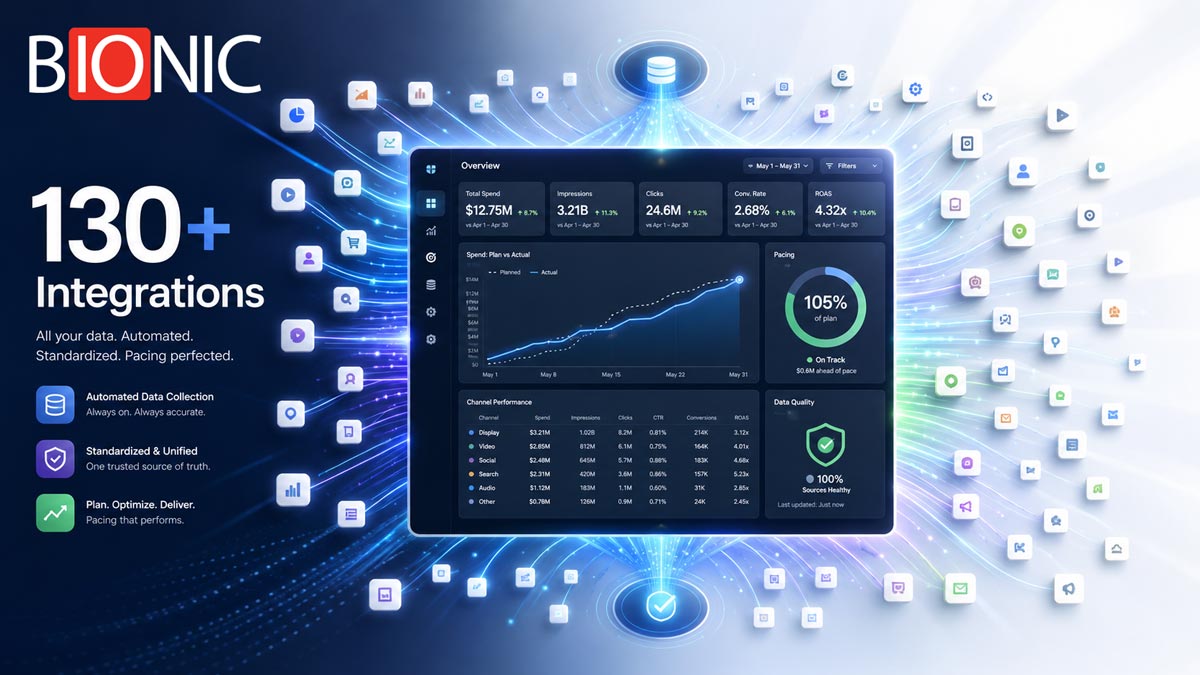
In its latest software update, Bionic for Agencies added 66 new integrations and upgraded 24 existing integrations to its media planning system, bringing its total to 130+ integrations.
You will find a full list of the integrations and details of the release at the bottom of this article.
In the meantime, it’s important to understand why this is a priority and why data integrations are so important for media planning and buying platforms like Bionic.
Data is Both a Blessing and a Curse of Modern Advertising.
One of the best things about modern advertising is all the data it gives you. You have access to real-time spending, impressions, clicks, conversions, and dozens of other KPIs available to you from 15,505 different advertising platforms (and counting).
On the flip side of the same coin, one of the worst things about modern advertising is you are expected to gather and analyze all this data. A single media plan might involve dozens of advertising platforms, each with their own custom interfaces, data points, and nomenclature.
Save Time, Eliminate Mistakes in Your Data Gathering.
A big challenge for media planning and media buying teams is gathering, standardizing, and centralizing all this data.
For spreadsheet-based agencies, data gathering is a nightmare.
Gathering the data requires logging into each platform, navigating to the right report, downloading the data, and manually transforming and transposing it into a master spreadsheet. This process takes hours and forces you to nervously cross a minefield of potential errors every time.
As a result, ad performance data is gathered infrequently, sometimes as little as once a month as part of vendor bill reconciliation. By waiting so long to analyze this data, you miss opportunities to optimize spending. As a result, advertising budgets are wasted.
For Bionic agencies, data gathering is 100% automated.
Every night, Bionic automatically gathers data from each of your platforms, cleans and standardizes it, and loads it into your centralized performance database.
When you arrive at work, your data is already loaded. As you sip your morning coffee, you review the previous day’s performance and notice anomalies that need attention.
Typical “Rear View” Dashboards Have Two Major Flaws.
Many advertising agencies have dashboarding systems that automate the advertising platform data gathering and enable you to visualize and report upon advertising performance.
This dashboarding software is excellent. However, it has two major flaws:
- It cannot tell you how your past performance compares to your plan.
- It cannot tell you your future plans.
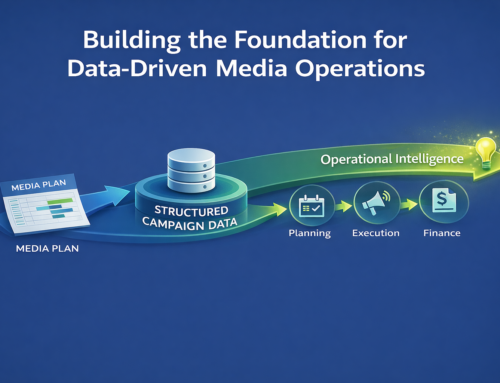
This is not the fault of the dashboarding software. The reason your dashboard cannot answer these questions is because it lacks the data. Because it lacks media plan data, your advertising dashboard can only provide actual performance data, not your plan data. If your media plan is an excel spreadsheet, you don’t have a good source of media plan data.
In contrast, Bionic gives you a source of media plan data.
When you create a media plan in Bionic, it feels like you are using a spreadsheet “on steroids” (with built-in templates, calculations, etc.). What you may not realize is what it’s doing behind the scenes…
For every KPI on every placement, Bionic creates a day-by-day plan for that Placement KPI. These behind-the-scenes calculations are tricky because they have to handle all the nuances of the placement configuration such as weekparting, flighting, etc.
The result of this data processing is a solid base of media plan data: for each placement, you get daily goals for spending, impressions, clicks, conversions, and all your other KPIs.
This data is not only available in the Bionic interface. It can also be delivered to your dashboarding system and any other system. When a data science team gets access to the Bionic data feed, they usually say something like, “finally, we have good, reliable media plan data!”
Increase Advertising Efficiency and Effectiveness.
With Bionic, you:
- Automate the process of creating media plan data.
- Automate the process of gathering performance data from platforms.
- Automate the process of comparing actual performance data to plan data, often known as “pacing.”
Now that you’ve automated all this grunt work and are getting fresh data every day, it opens up possibilities to improve the efficiency and effectiveness of your advertising.
By eliminating all the data gathering work, you now have more time to analyze the performance data. By serving up this data on a silver platter, it becomes easier to identify the insights that enable you to optimize your advertising.
What You Got with This Free Software Upgrade.
The latest upgrade of Bionic (version 2026.1.0) is a major release, including more than 100 product improvements. Although the most notable relate to new integrations, most of the improvements were small changes to improve the speed and reliability of the software.
The Bionic <> Supermetrics Partnership
You may be wondering how Bionic all of the sudden added all of these integrations all at once. This is a result of our new partnership with Supermetrics.
After months of research and careful vetting, we chose Supermetrics as a preferred connector/reporting partner because it is highly aligned with marketing teams and agencies and they have a proven track record.
Supermetrics is a Helsinki-based software company founded in 2013 that provides a Marketing Intelligence Platform that helps teams connect, manage, analyze, and activate marketing data. Supermetrics’ proven and trusted platform fuels insights for 200,000+ companies in 120 countries, including big names like dentsu, McCann, Nestlé, Warner Bros., L’Oréal, HubSpot, and iProspect.
Bionic is the operational system of record for media plans, buys, budgets, pacing, authorizations, reconciliation, and finance. Supermetrics is a marketing-data pipeline for performance, analytics, and dashboards. This new partnership enables you to better connect “what we planned and bought” with “what actually happened in market.”
New Bionic Integrations Available
As a result of the Supermetrics partnership, you now have access to a bunch of new integrations, including:
- ActiveCampaign
- Adjust
- AdRoll
- Adtraction
- Affluent
- Amazon DSP
- AppsFlyer
- Awin
- Axon by AppLovin
- Beeswax
- Branch
- Brevo
- Campaign Monitor
- Celtra
- CJ Affiliate
- Criteo
- Criteo Retail Media
- DoubleVerify
- Eskimi
- Everflow
- Facebook Billing Data
- Facebook Insights
- Google AdSense
- HubSpot Marketing Emails
- HubSpot Marketing Forms
- Ignite
- Impact
- Instagram Insights
- IQM
- Klaviyo
- Kwai Ads
- Lazada Ads
- Liftoff
- LINE Ads
- LinkedIn Company Pages
- LiveIntent
- MailChimp
- Marketo
- Meltwater
- MNTN
- Moloco DSP
- Nexxen DSP
- Omnisend
- Outbrain Amplify
- Partnerize
- Pinterest Organic
- Quantcast
- Quora Ads
- Rakuten Advertising
- Readpeak
- RTB House
- Shopee Ads
- Sprinklr
- Sprout Social
- Teads
- Threads Insights
- TikTok Organic
- Tradedoubler
- Vibe
- Walmart Connect (Display)
- Walmart Connect (Search)
- Xing Ads
- Yahoo! Japan Display Ads
- Yahoo! Japan Search Ads
- Yelp Reviews
- YouTube
Upgraded Bionic Integrations
In addition, you now have an easier alternative to existing integrations.
Previously, the integrations listed below were based on a scheduled data feed. Now, you have the option to switch to an API-based data pull. The end result of either method is the same, but the new API method is a lot easier to set up.
Here is a list of the upgraded integrations:
- Adform
- Amazon Ads
- Apple Search Ads
- Basis
- Flashtalking
- Google Ad Manager
- Google Ads
- Google Analytics 4
- Google Display & Video 360
- Google Search Ads 360
- Integral Ad Science
- LinkedIn Ads
- Microsoft Advertising (Bing)
- Outbrain DSP (Zemanta)
- Pinterest Ads
- Reddit Ads
- Snapchat Marketing
- Spotify Ads
- StackAdapt
- Taboola
- The Trade Desk
- TikTok Ads
- X Ads (Twitter)
- Yahoo DSP
For a complete list of Bionic integrations, see Media Planning and Media Buying Software Integrations.
Speed and Reliability Improvements
This release also included 43 speed and reliability improvements.
The primary source of these improvements is customer feedback. If something in Bionic is not quite right, we want to know. We appreciate those customers who took the time to tell us how the product needs to be improved. This type of feedback gets prioritized over other product ideas.
We also identified a number of improvements through our always on product monitoring that measures the speed of each of the actions in the system and any glitches that occur.
How to Get the New Software.
If you’re a Bionic customer, you’ve already got the latest software as part of your Bionic subscription, which includes free upgrades. We have already upgraded your account with the latest and greatest software.
To learn more about the new features, contact your dedicated Customer Success Manager or our customer support team. We’d love to help you to get the most value from new features!
If you’re not yet using Bionic, you can request a trial to get started.