Global advertising has crossed a milestone that seemed remarkable only a few years ago: the worldwide advertising market is now worth more than $1 trillion per year.
But where is all that money going?
Here’s how the 2026 global media market breaks down into total advertising, digital advertising, programmatic advertising, walled gardens, the open internet, and the increasingly important role of algorithms and AI.
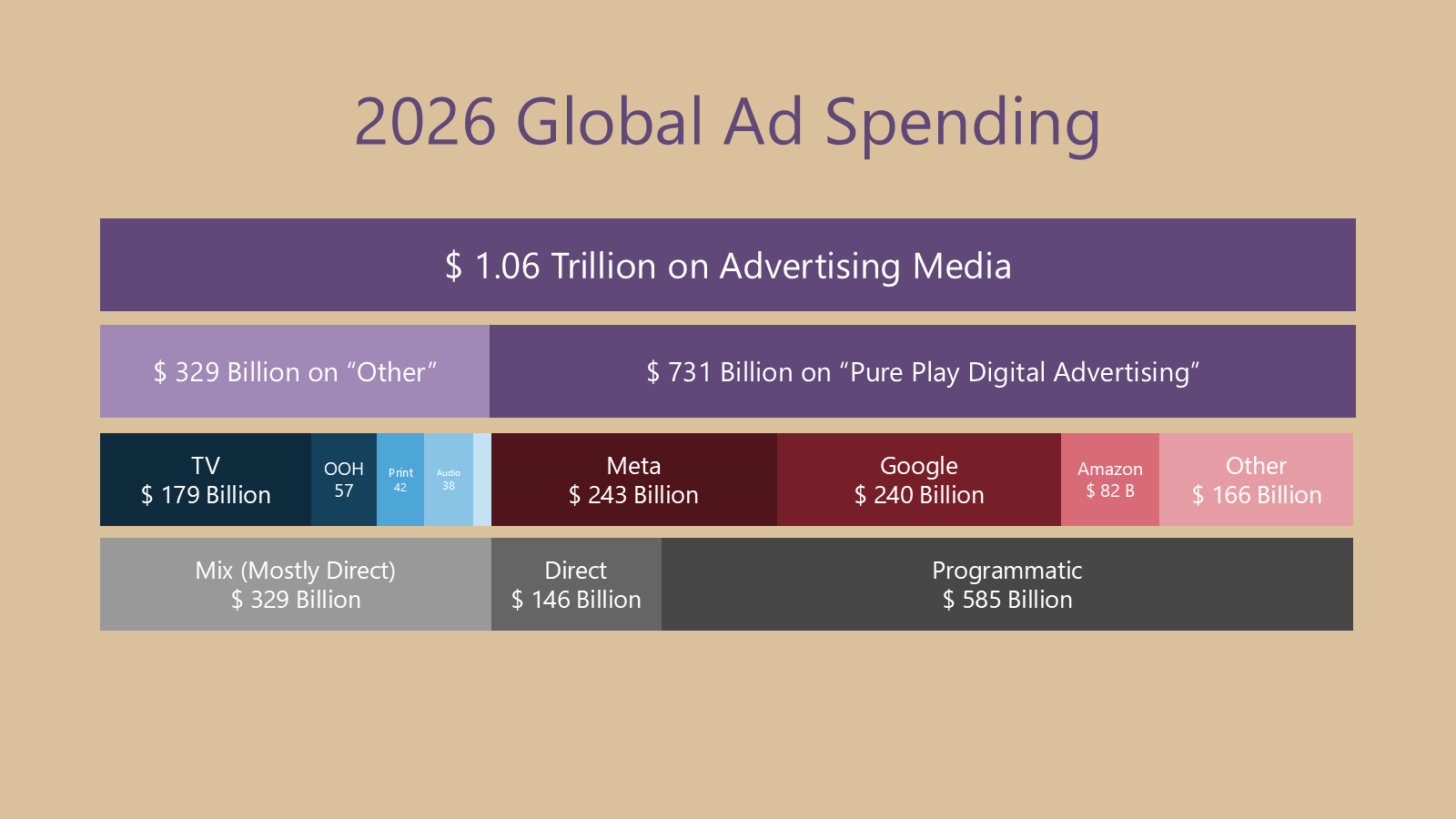
$1.06 Trillion on Advertising Media
Advertising media are the placements used to deliver promotional messages through channels including television, search, social media, websites, streaming video, retail media, audio, print, outdoor, and other media.
Dentsu’s May 2026 forecast estimates worldwide advertising spending will reach $1.06 trillion in 2026, growing approximately 5.0% over 2025.
That’s a major milestone. Dentsu now estimates that global advertising actually crossed the $1 trillion threshold during 2025, a year earlier than it had previously expected.
For perspective, the International Monetary Fund currently forecasts global economic growth of 3.0% in 2026, meaning advertising is expected to grow considerably faster than the overall world economy.
About $731 Billion on Pure Play Digital Advertising
Digital continues to take a larger share of the advertising market.
Dentsu estimates that digital will represent approximately 69% of worldwide advertising spending in 2026.
Applying that share to Dentsu’s $1.06 trillion global forecast:
$1.06 trillion × 69% ≈ $731.4 billion
So, roughly $731 billion will be spent on pure-play digital advertising worldwide in 2026.
That includes major digital categories such as search, social, online video, retail media, and other digital advertising.
One important clarification: Dentsu defines “digital” as pure-play digital platforms. Digital extensions of traditional media (e.g., digital newspaper advertising) are included within their respective media channels rather than in this digital category.
About $329 Billion on Television, OOH, Print, Audio, Cinema, and Other Media
The remaining 31% of worldwide advertising spending, approximately $329 billion, will go to media outside Dentsu’s pure-play digital category in 2026.
Using their December 2025 channel mix, Television remains by far the largest of these media, accounting for roughly $179 billion, followed by out-of-home at approximately $57 billion, print at $42 billion, audio at $38 billion, cinema at about $4.5 billion, and other media accounting for the remainder.
These shouldn’t simply be characterized as “offline” media. Dentsu includes the digital extensions of traditional media within their respective categories. Connected television, for example, is counted within television; digital out-of-home within OOH; streaming and podcast advertising within audio; and digital newspaper and magazine advertising within print.
That distinction is becoming increasingly important. Dentsu’s December forecast estimated that digital formats would account for 23.8% of television, 33.1% of OOH, 37.9% of print, and 28.8% of audio advertising spending in 2026.
The media world is becoming less digital-versus-traditional and more of a continuum.
More Than 80% of Digital Advertising Is Programmatic
Programmatic advertising is the automated buying and selling of advertising media using software, data, algorithms, and artificial intelligence.
Dentsu forecasts that more than four-fifths of digital advertising investment will be programmatic in 2026. With digital representing approximately $731 billion of worldwide advertising spending, that implies at least roughly $585 billion in programmatically transacted digital advertising.
This does not mean the remaining $475 billion of global advertising spending is manually purchased. Dentsu’s digital category excludes digital extensions of traditional media such as connected television, digital out-of-home, digital audio, and digital print, some of which are also bought programmatically. In addition, major closed platforms increasingly use algorithms to automate buying decisions even when those transactions are not described in the same way as open-web programmatic buying.
Here’s a better way to break down the remainder of the advertising pie:
- The remaining $146 billion of pure-play digital is transacted via direct publisher/platform buys.
- The $329 billion of other non-pure play digital is a mix of direct and programmatic. Although this segment is still predominantly direct insertion order-based buying, it’s increasingly automated/programmatic buying.
Automated decision-making is becoming the default way advertising is bought. Dentsu forecasts that 75% of all advertising spending (not merely digital advertising) will be algorithmically transacted by 2028.
More Than 60% of Digital Advertising Goes to Just Three Walled Gardens
“Walled gardens” are closed advertising ecosystems in which a platform controls much of the audience data, targeting, buying technology, ad inventory, and measurement.
EMARKETER forecasts that Meta, Google, and Amazon alone will capture 62.3% of worldwide digital advertising spending in 2026. Those three companies represent only a subset of the broader walled-garden ecosystem, which also includes platforms such as TikTok, Microsoft, Apple, and major retail-media networks
In an especially noteworthy changing of the guard, EMARKETER expects Meta to generate $243.46 billion in worldwide digital advertising revenue during 2026, narrowly surpassing Google’s projected $239.54 billion and making Meta the world’s largest digital advertising company by this measure.
How Much Advertising Goes Through DSPs?
Demand Side Platforms, or DSPs, are software platforms advertisers and agencies use to buy advertising programmatically across multiple publishers, exchanges, and other sources of inventory.
Unlike digital, programmatic, walled-garden, and open-internet spending, there is no clean global figure for “media spending through DSPs.”
That’s partly because DSPs are infrastructure rather than a mutually exclusive media category. A dollar of open-web programmatic advertising might pass through a DSP, an exchange, one or more SSPs, and a publisher before the transaction is complete.
For that reason, estimates of the DSP market size generally measure revenue earned by DSP technology companies rather than the total amount advertisers spend on media using those systems.
How Much Advertising Goes Through SSPs?
The same problem exists with Supply Side Platforms, or SSPs.
SSPs enable publishers and other media owners to manage, sell, and optimize advertising inventory programmatically.
A media dollar can touch both a DSP and an SSP during the same transaction. Therefore, DSP and SSP spending cannot simply be added to the advertising-spending categories above.
There does not appear to be a reliable worldwide estimate of gross advertising media spending transacted specifically through SSPs.
The Biggest Change in 2026: Algorithms Are Becoming the Media Market
The most interesting change since our 2023 Media Spending Forecast isn’t simply that the numbers have gotten bigger.
It’s that the distinction between “digital advertising” and everything else is starting to become less useful.
Retail media, connected TV, digital out-of-home, streaming video, commerce media, search, and social are increasingly bought and optimized using algorithms. Dentsu expects retail media, CTV and video, social, and digital OOH to be among the fastest-growing areas of advertising in 2026.
Artificial intelligence is accelerating that transition.
WPP Media describes AI investment as one of the major forces supporting advertising growth in 2026. It forecasts that generative search advertising alone will grow from approximately $5.1 billion in 2026 to more than $100 billion by 2030.
Commerce is also becoming increasingly central to media. Dentsu’s December forecast had retail media growing 14.1% in 2026, ahead of online video at 11.5% and social at 11.4%.
The future of media buying increasingly looks less like choosing individual media vehicles and more like managing a portfolio of interconnected, algorithmically controlled advertising systems.
Why Advertising Forecasts Don’t Agree
You may see very different numbers for the size of the 2026 advertising market.
For example, Dentsu currently forecasts $1.06 trillion in worldwide advertising spending.
EMARKETER forecasts approximately $1.17 trillion in worldwide media advertising spending.
WPP Media forecasts an even larger $1.3 trillion in global advertising revenue, excluding U.S. political advertising.
These numbers aren’t necessarily contradictory.
Advertising forecasters differ in what they count, whether they measure advertiser expenditure or media-owner revenue, how they treat discounts and commissions, which digital extensions they assign to which channels, exchange-rate assumptions, geographic coverage, political advertising, and increasingly how they classify commerce media, creator media, and new forms of AI advertising.
So, it’s dangerous to take one category from one forecast, another category from a second forecast, and assume the pieces fit together perfectly.
For this analysis, I’ve primarily used Dentsu’s numbers so the major pieces of the spending calculation share a common methodology.
Omnichannel Media Planning and Media Buying
Three years ago, we wrote that advertising budgets were splintering into more and more pieces.
That fragmentation has only accelerated.
Today a single advertising budget may include linear television, streaming TV, search, social, retail media, podcasts, digital audio, out-of-home, programmatic display, native advertising, influencers, sponsorships, and dozens of individual advertising platforms.
And increasingly, each platform has its own data, algorithms, buying systems, measurement methodology, and terminology.
That’s why an omnichannel view of the media plan is more important than ever.
Bionic for Agencies enables media teams to plan and buy advertising across all of these channels in a single media plan, whether the investment is traditional, digital, programmatic, platform-direct, or some combination of all of them.
The media ecosystem may be getting more fragmented.
Your media plan doesn’t have to be.
Sources
Dentsu, “Ad Spend Growth Is Projected to Slow to 5.0% in 2026, Still Outpacing Economic Growth,” May 27, 2026.
Dentsu, “Global Ad Spend Set to Surpass $1 Trillion for the First Time in 2026 as the Algorithmic Era Redefines Growth,” December 3, 2025.
WPP Media, “This Year Next Year 2026 Midyear Forecast: Global ad revenue to grow 8.9% to $1.3 trillion,” June 16, 2026.
EMARKETER, “Worldwide Ad Spending H1 2026,” May 2026.
EMARKETER, “Meta to Surpass Google in Digital Ad Revenues for First Time Ever,” April 13, 2026.
International Monetary Fund, World Economic Outlook Update, July 2026, projecting 3.0% global economic growth in 2026.