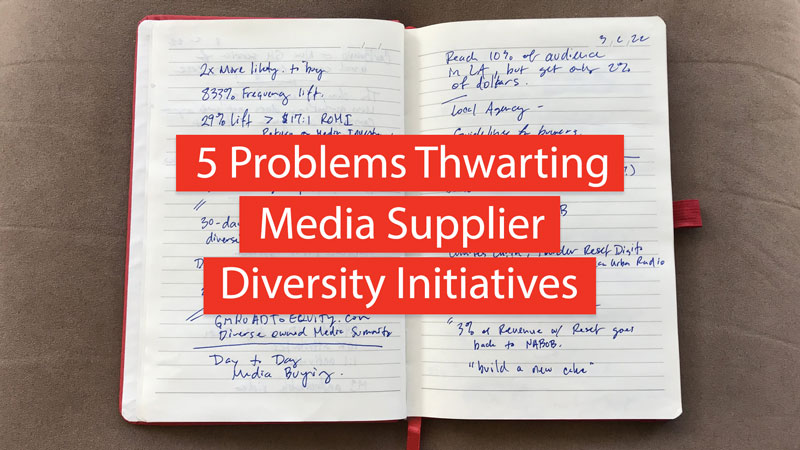
On March 2-4, 2022 in Orlando, the Association of National Advertisers (ANA) held their 10th annual Media Conference. The ANA led the conference with a program focused on supplier diversity, which both celebrated progress and identified the problems thwarting these initiatives.
As usual, the Media Conference delivered an abundance of insights which furiously filled my notebook. Here is a summary of my notes and quotes related to supplier diversity initiatives, along with links to related resources.
Diversity is Good for Business
“The biggest myth about the inclusion opportunity in media is it does not build the business. We have evidence that’s not the case. It does build the business,” said Charlotte La Niear, Senior Director U.S. Multicultural Media at Procter & Gamble during the first panel discussion of the conference.
“If you’re not doing multicultural marketing, you’re not doing marketing,” declared Marc Pritchard, Chief Brand Officer at Procter & Gamble during his keynote presentation.
Pritchard elaborated, “Building the multicultural market may be the single biggest growth opportunity in our industry. Nearly 100% of population growth in the past 10 years came from Black, Hispanic, Asian Pacific Islander, Native Indigenous, multiracial, and multi-ethnic segments of the population. Multicultural buying power is now worth $5.4 trillion and has been the driver of market growth for a decade. More than half of P&G sales growth in North America came from multicultural consumer segments. Closing the multicultural share gap is worth $500 million in extra sales annually.”
Systemic Bias Requires Systematic Change
“To be frank, historically, the ad industry has not been too kind to Black-owned media,” said Devon Johnson, Founder & CEO at BleuLife Media Group and Co-Founder of BOMESI – the Black Owned Media Equity and Sustainability Institute.
Johnson continued, “Whether it’s payment terms, scale terms, the industry has not been kind. A lot of repairing of the past has to happen. We don’t get to just jump into 2022 and pretend that historically Black-owned media, which has been around for 190+ years, is all set. One of the first industries that formerly enslaved individuals started were media companies to tell their story. We never had a chance to thrive. We just survived in an industry that has excluded us for almost 200 years. So, how do we repair that? That means changing the way it used to be because the way it used to be did not include us and wasn’t for us. And find a new way forward.”
La Niear commented, “as Jim Winston says, we need to build a new cake.” Winston is the President of NABOB – the National Association of Black Owned Broadcasters.
There’s Strong Initiative
“It starts with intention,” advised Sherman Kizart, Managing Director at Kizart Media Partners. Without intention, diversity programs lack the mandate to get the resources and support needed to make a meaningful impact.
“You don’t get to unbias yourself, but you do get to preference the bias you want. So, choose to be intentional,” urged Charles Cantu, Founder & CEO at Reset Digital.
Members of the ANA have strong initiative behind their diversity programs.
According to the ANA’s May 2021 Growth of Supplier Diversity Report, almost 90% of respondents indicated the importance of supplier diversity had increased, with 58% indicating that it had increased significantly. According to Bill Duggan, Group Executive Vice President at the ANA, “If we did this survey today, I think the numbers would probably be even higher.”
Leading advertisers and agencies announced diversity initiatives at the conference. GroupM has pledged to invest more than 2% in Black-owned media through their Media Inclusion Initiative. GM plans to increase investment in Black-owned media from 2% in 2021 to 4% in 2022.
These initiatives are making an impact. According to Cantu, “It’s an amazing and wonderful time to be in diverse media.”
We Have a Long Way to Go
Despite the motivation, many diversity initiatives have “a long way to go” before achieving their goals.
“The first challenge is admitting that we have work to do. This is not an easy solve. We need to identify the root cause,” said Tony Wells, SVP and Chief Media Officer at Verizon.
Kirk McDonald, CEO at GroupM observed, “It’s not a problem with objectives. It’s with execution.”
The root causes holding back supplier diversity initiatives were discussed throughout the conference.
Lack of Diverse Talent
A core problem hampering supplier diversity is lack of diversity on media buying teams.
“At the agency-level, any agency you walk into anywhere at any time, there are very few people that look like I do,” said Michele Dudley, Media Buyer at MD Media.
Brands are driving staff diversity through internal programs and through agency selection and reviews.
Wells requires his agencies to report on diversity, equity, and inclusion in all reviews. He asks them to report on the makeup of their teams. He asks how they are impacting Verizon’s GEM score and other measures.
“When you have diverse talent, you get diverse thinking,” remarked McDonald.
Lack of Communication
Another problem thwarting supplier diversity initiatives is lack of communication and clear direction to those making media buying decisions.
Dudley placed the cornerstone of the conference when she said, “What we often hear from the advertiser at the top is you would like to expand your multicultural advertising. And then as it trickles down from you, to the people who work for you, to the people who work for them, to the people who work for them, who work for them, who work for you, and then to your ad agency. By the time it gets to the ad agency, no one wants to talk to us anymore.”
It’s clear that systematic change is needed to ensure that media buyers understand the diversity objectives while making purchasing decisions.
Hard to Find Diverse Suppliers
It’s difficult to source diverse media suppliers.
According to ANA’s Supplier Diversity Report, the top two challenges for supplier diversity are “Finding diverse suppliers” (68% of respondents) and “Visibility to opportunities to recommend diverse suppliers” (52% of respondents).
The industry is working to overcome these challenges. Over the last two years, The ANA has compiled a Diverse Suppliers Directory. The 4A’s has compiled a station by station BIPOC Owned Media Companies Resource List for TV and Radio. Other such directories are available.
Despite this progress, finding diverse suppliers remains a top challenge. Why?
Media planners and media buyers simply don’t have the time to leverage these resources while constructing media plans.
The media team is always under time pressure and already working long hours. Existing resources require them to leave their media system, go to a vendor directory, filter to get the media vendors, go to each vendor’s website to get a basic understand of the inventory, send RFPs to gain full understanding, manually add to media plan, and then finally create and send an insertion order. This process would add many hours of extra work to every media plan. Nobody has this time available. So, it doesn’t happen.
We can’t expect media planners and media buyers to do all this extra work. We need to make it easier for media teams to source diverse suppliers.
Lack of Tools
Another problem cited is lack of tools to properly measure and transact with diverse media suppliers.
McDonald channeled Rishad Tobaccowala in saying, “when you fill out the same media template that you’ve used for the last 10 years, it’s hard to come up with a different answer when you’re using the containers of the past.”
Diverse suppliers often lack the staff and infrastructure of large organizations.
Rhonesha Byng, Founder and CEO at HerAgenda.com and Co-Founder of BOMESI stated, “for a Black-owned media company to have 5 full-time staff, that’s actually a lot. It’s great to get so much interest and enthusiasm, but it’s a bit overwhelming. Even with just one agency, with multiple clients. Getting asked to answer the same questions over and over. Getting asked to fill the same excel spreadsheets over and over. The bandwidth is limited.”
We need to make it easier for diverse suppliers to participate in deals.
We also need to understand that traditional measurement systems are flawed when it comes to diverse media.
“Polling is limited. It’s absolutely a sampling issue,” said Chesley Maddox-Dorsey, CEO at American Urban Radio Networks and founding member of NABOB.
McDonald also said, “If you don’t give permission to your media department to evaluate those media at different CPMs and at different measures of accountability, you’ve not recognized that some of those partners are not measured in the same way as your media companies that you’ve worked with over the last 10 years, and last 20 years. So, now you’re asking the future to fit into a container of the past. Guess what then happens? You optimize out of that because you can buy the audience in another environment. And now you’re not supporting the thing that you claim you want to support. And now I’m telling you that if you keep making the promises of being authentic but not holding to yourselves to the integrity of doing it different, you’re going to get busted.”
Lack of Accountability
Even with clear communication of diversity objectives, diversity initiatives fail when not held accountable to those objectives.
Wells cited an old Marine adage, “inspect what you expect.”
We need a diversity scorecard integrated throughout the media buying process. For example, a diversity scorecard should be available when making media planning placement decisions, when analyzing media plans, when presenting media authorizations for approval, and when reporting on media spending.
Your Next Steps
Taken together, overcoming these problems may seem like a daunting challenge. I came away from the conference with a scary long list of action items for myself and for my product team. However, the best advice is to start small then build on your success.
When asked what’s one thing we can do to help to overcome systemic bias in media ecosystem, La Niear responded simply, “identify one new partner.”
Another next step to consider is attending the ANA’s Advertising Financial Management Conference in May. According to the ANA’s Growth of Supplier Diversity Report, in 63% of organizations, the supplier diversity role resides in Procurement (vs. only 13% in Marketing). Procurement is a key subject of the AFM conference, and the conference will lead with a program focused on supplier diversity.
Finally, you can start your day tomorrow thinking about how you can improve diversity in your supplier decisions. As Wells advised, “you just have to get up every day and get after it.”
Let’s get after it!